

Northern Nevada has always been known for its dramatic landscapes, outdoor lifestyle and independent spirit. But beneath the familiar image of open land, mountain views and historic communities, something much larger has been taking shape.
The region is becoming an increasingly important center for technology, advanced manufacturing, data infrastructure, energy storage, logistics and research.
Companies including Tesla, Panasonic Energy, Google, Apple, Microsoft, Switch, Amazon and Redwood Materials have established operations or made significant investments in Northern Nevada. At the same time, the University of Nevada, Reno, regional economic-development organizations and a growing network of entrepreneurs are helping create an economy that looks very different from the Northern Nevada of a generation ago.
This evolution does not mean the region is trying to become another Silicon Valley. That is not what makes Northern Nevada special.
Its strength comes from offering something different: access to major Western markets, a business-friendly environment, an expanding innovation ecosystem and a quality of life that still includes wide-open spaces, smaller communities and immediate access to the Sierra Nevada.
For homeowners, buyers, sellers and people considering a move to the region, understanding this economic transformation matters. Employment, infrastructure, population patterns and housing demand are all connected—but not always in the simple or predictable ways people assume.
Table of Contents
- Northern Nevada’s Economy Is Becoming More Diverse
- Why Technology and Industry Are Choosing Northern Nevada
- The Tahoe-Reno Industrial Center
- Major Companies Operating in Northern Nevada
- The Emerging Lithium and Battery Economy
- The University of Nevada, Reno and the Innovation Ecosystem
- How Economic Growth Is Affecting Local Communities
- What Growth May Mean for Northern Nevada Real Estate
- The Other Side of Growth
- What Buyers Should Consider
- What Northern Nevada Homeowners Should Consider
- Our Perspective
- Frequently Asked Questions
Northern Nevada’s Economy Is Becoming More Diverse
For decades, Nevada’s economy was commonly associated with gaming, hospitality, tourism and mining. Those industries remain important, but they no longer tell the entire story.
Northern Nevada has been steadily developing a broader economic base that includes:
- Advanced manufacturing
- Electric vehicles and battery production
- Data centers and cloud infrastructure
- Software and technology
- Logistics and distribution
- Aerospace and defense
- Mining technology
- Clean energy
- Health care and life sciences
- Research and higher education
This diversification is significant because a region supported by multiple industries may be better positioned to withstand economic changes than one dependent on a single employment sector.
The Economic Development Authority of Western Nevada reported that 26 new or expanding primary companies invested in Northern Nevada during 2025, representing more than 600 jobs and approximately $327 million in capital expenditures.
These numbers tell only part of the story. The larger shift is that Northern Nevada is attracting employers, investment and workers whose decisions are based on more than proximity to casinos or tourism.
They are choosing the region because of its location, transportation access, available industrial land, tax structure, educational resources and Western lifestyle.
Why Technology and Industry Are Choosing Northern Nevada
Northern Nevada occupies a strategic position in the Western United States.
Reno and Sparks sit along Interstate 80, one of the country’s major east-west transportation routes. The region also offers access to rail service, Reno-Tahoe International Airport and major population centers throughout California and the West.
Northern Nevada is within a one-day truck drive of more than 60 million customers and several major Pacific ports, according to regional economic-development materials. That location can be especially valuable for companies involved in manufacturing, distribution, e-commerce and technology infrastructure.
Nevada’s tax environment is another part of the equation. The state does not impose an individual state income tax or a traditional corporate income tax. However, Nevada businesses may be subject to other taxes, including the Commerce Tax and Modified Business Tax, depending on their operations and revenue.
Taxes are only one factor in a corporate-location decision. Companies also evaluate land, power, water, transportation, workforce availability, permitting, construction costs and access to customers.
Northern Nevada’s appeal comes from the combination of these factors rather than from any single advantage.
The Tahoe-Reno Industrial Center
One of the most important pieces of Northern Nevada’s economic transformation is the Tahoe-Reno Industrial Center, commonly known as TRIC.
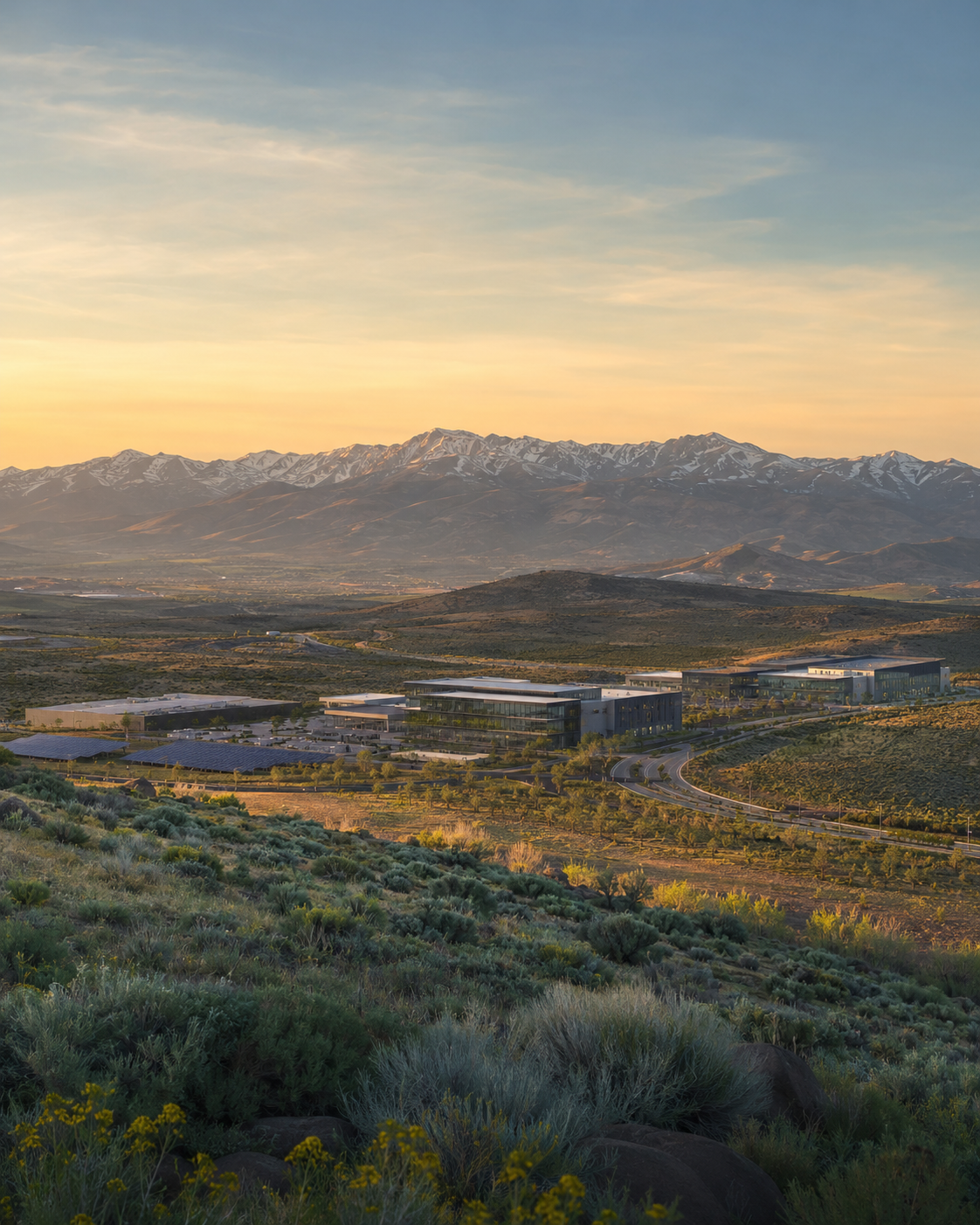
Located in Storey County east of Reno and Sparks, TRIC is one of the largest industrial parks in the world. It has attracted major businesses involved in manufacturing, technology, distribution and data infrastructure.
Its location near Interstate 80 and proximity to the Reno-Sparks metropolitan area have helped make it a major regional employment center. The opening of USA Parkway between Interstate 80 and U.S. Highway 50 also created a direct connection between the industrial center and communities to the south.
That connection matters because many people employed in or around TRIC do not live in Storey County. They may commute from Reno, Sparks, Fernley, Dayton, Silver Springs, Carson City or other surrounding communities.
The effects of the industrial center therefore extend well beyond its physical boundaries. Its influence can be seen in transportation patterns, housing decisions, commercial development and infrastructure planning across several Northern Nevada counties.
Major Companies Operating in Northern Nevada
Northern Nevada’s economic story is not based on one company alone. A collection of prominent employers and industries has helped reshape the region.
Tesla and Panasonic Energy
Tesla’s Gigafactory at the Tahoe-Reno Industrial Center brought international attention to Northern Nevada’s potential as an advanced-manufacturing location.
The facility’s battery and electric-vehicle operations helped place the region within the global conversation about transportation technology and energy storage. Panasonic Energy’s presence further strengthened the battery-manufacturing ecosystem developing in the area.
The arrival of these companies did more than create employment. It helped demonstrate that large-scale, technology-driven manufacturing could operate in Northern Nevada.
Google, Apple, Microsoft and Switch
Northern Nevada has also attracted major investments in digital infrastructure.
Google operates a data center in Storey County. Apple, Microsoft and Switch have also established significant technology or data-related operations in the region.
Data centers are very different from traditional office campuses. They may require substantial investments in buildings, equipment, power, cooling and network infrastructure while creating fewer permanent jobs than a similarly sized conventional office development.
Their importance should therefore be evaluated through more than job counts alone. Data centers can contribute to capital investment, construction activity, tax revenue, infrastructure development and Northern Nevada’s broader position within the digital economy.
Amazon and the Logistics Sector
Northern Nevada’s transportation access has made the region attractive to logistics, distribution and e-commerce companies.
Amazon is among the recognizable names operating in the area, but the logistics sector includes many other businesses serving Western markets.
Warehousing and distribution growth has created jobs and commercial activity while also increasing the importance of regional transportation planning. Truck traffic, employee commuting, roadway capacity and the availability of workforce housing are all part of the larger picture.
Redwood Materials
Redwood Materials is helping expand Northern Nevada’s role in the battery-materials and recycling industry.
The company’s work focuses on recovering and producing materials used in lithium-ion batteries. Nevada economic-development documents have described a planned investment of approximately $1.1 billion associated with the company’s expansion and an estimated 700 jobs.
Redwood Materials represents an important evolution in the regional economy. Northern Nevada is not only participating in battery manufacturing; it is also developing expertise in the recovery, processing and reuse of critical battery materials.
The Emerging Lithium and Battery Economy
Nevada has significant lithium resources, a long history of mining and a growing concentration of battery-related companies and research.
Together, these assets have contributed to what economic-development organizations sometimes call the “Lithium Loop”—an effort to build more of the battery supply chain within Nevada.
That supply chain can include:
- Mineral extraction
- Materials processing
- Battery-component production
- Battery manufacturing
- Electric-vehicle manufacturing
- Battery recycling and material recovery
- University research and workforce education
Building an integrated supply chain is a much larger undertaking than attracting a single factory. It requires research, specialized workers, transportation, energy, water, environmental review and long-term investment.
Northern Nevada’s combination of mineral resources, manufacturing operations, recycling expertise and university research gives it a potentially important position within this growing industry.
The opportunity is significant, but responsible development matters. Mining, manufacturing and population growth must be evaluated alongside water availability, infrastructure, environmental stewardship and the long-term interests of local communities.
The University of Nevada, Reno and the Innovation Ecosystem
A sustainable technology economy needs more than industrial land and favorable taxes. It needs educated workers, research, entrepreneurship and collaboration.
The University of Nevada, Reno is a Carnegie R1 research university, a designation recognizing a high level of research activity. Its work supports areas including engineering, advanced manufacturing, environmental science, mining, computing, health care and entrepreneurship.
The university also contributes to the regional workforce. Graduates who remain in Northern Nevada help create a deeper pool of employees for established companies, growing businesses and startups.
Research institutions can also help translate ideas into commercial applications. Faculty, students, laboratories, entrepreneurs and private companies may work together to address challenges involving energy, water, transportation, mining and technology.
This is one reason Northern Nevada’s growth should not be viewed solely as a collection of large corporations moving into the area. A genuine innovation economy also depends on local businesses, skilled trades, professional services, health care providers and entrepreneurs.
How Economic Growth Is Affecting Local Communities
Economic growth does not stop at a city or county boundary.
A person may work in Storey County, live in Fernley, shop in Sparks and spend weekends in Carson City or Lake Tahoe. Another employee may work remotely for a technology company while choosing to live in Minden, Gardnerville or Genoa because of the lifestyle.
That movement of people and employment creates different opportunities and pressures throughout the region.
Reno and Sparks
Reno and Sparks remain the region’s primary employment, education, health care and commercial centers. They offer the greatest variety of housing, services and urban amenities while maintaining close access to outdoor recreation.
Continued job creation can support housing demand, but conditions vary considerably by neighborhood, property type and price range.
Fernley and the Interstate 80 Corridor
Fernley’s location east of the Tahoe-Reno Industrial Center can appeal to employees seeking access to major employment areas along Interstate 80.
The community has experienced meaningful residential and commercial growth, but buyers should still consider commute times, services, future development and the type of lifestyle they want.
Dayton and the U.S. Highway 50 Corridor
USA Parkway created a more direct connection between U.S. Highway 50 and the Tahoe-Reno Industrial Center. That has increased the strategic importance of communities along the highway, including Dayton and Silver Springs.
Transportation access can influence housing decisions, although commute convenience should never be assumed from a map alone. Travel time, road conditions, work schedules and weather can all affect the experience.
Carson City
Carson City offers state-government employment, health care, services and a central location between Reno, Carson Valley and Lake Tahoe.
Its economy is not dependent on the technology sector, but the city can benefit from broader regional growth and from people seeking a smaller community with access to several Northern Nevada employment centers.
Minden, Gardnerville and Genoa
Carson Valley offers a different experience from Reno and Sparks.
Many residents are drawn to its open space, Sierra views, community character and proximity to Lake Tahoe. Some work locally, some commute to Carson City or Reno, and others work remotely.
The Valley is not simply a bedroom community for Reno’s technology economy. It has its own identity, agricultural history, businesses and lifestyle. However, regional employment growth can still influence who considers moving there and what types of homes they seek.
If you are comparing these communities, our guide to living in Carson Valley and our comparison of Gardnerville versus Minden provide a closer look at their differences.
What Growth May Mean for Northern Nevada Real Estate
Economic growth can support housing demand, but it does not guarantee that every home will increase in value or sell quickly.
Real estate remains highly local.
A region can add jobs while individual neighborhoods experience different results. Housing performance may vary according to:
- Location
- Price range
- Property type
- Inventory
- Interest rates
- Condition
- Insurance costs
- Commute patterns
- New construction
- Buyer preferences
- Overall affordability
Employment growth can bring new buyers and renters into a region. It can also encourage existing homeowners to move within the area as their careers, income or family needs change.
At the same time, higher housing costs may make it harder for teachers, nurses, first responders, service workers and other essential employees to live near their jobs. A healthy regional economy requires housing at different price points—not only luxury homes or large new developments.
This is why broad headlines about population growth or major employers should never replace a property-specific real estate analysis.
The Other Side of Growth
Growth creates opportunity, but it also creates responsibility.
Northern Nevada must continue addressing:
- Housing supply and affordability
- Road capacity and commuting
- Water availability
- Energy demand
- Schools and public services
- Health care capacity
- Wildfire planning
- Environmental protection
- Preservation of community character
Water is especially important in an arid state. Buyers considering acreage, private wells, agricultural property or development potential should understand that water rights and physical water availability are not the same thing.
A property can have attractive land and impressive views while still requiring careful investigation of its water source, domestic-well records, permitted uses and any separate water rights.
Growth should be measured not only by the number of companies or jobs a region attracts, but by whether communities can absorb that growth while preserving the qualities that made people want to live there in the first place.
What Buyers Should Consider
Buyers relocating for employment sometimes begin their home search by asking, “What is the closest community to my job?”
That is an important question—but it should not be the only one.
A better decision considers the full lifestyle:
- How often will you commute?
- Will you work remotely for part of the week?
- Do you prefer an urban, suburban, rural or small-town setting?
- How important is access to Lake Tahoe or the Sierra?
- Do you need an airport nearby?
- Are you comfortable with winter driving?
- Would you prefer a newer home or an established neighborhood?
- Do you want acreage, an HOA community or a lower-maintenance property?
- How do property taxes, insurance and utilities fit into your budget?
- Are you planning to remain in the area long enough for buying to make sense?
Someone working near TRIC may choose Sparks for convenience, Fernley for a different price point, South Reno for amenities, Carson City for its central location or Carson Valley for open space and a quieter pace.
There is no universally “best” community. The right choice depends on how you want your life to work—not simply where your employer is located.
For a broader overview, read our complete guide to relocating from California to Northern Nevada.
What Northern Nevada Homeowners Should Consider
Homeowners may reasonably wonder whether regional job and population growth means it is automatically a good time to sell.
The answer depends on the individual property and the owner’s goals.
Economic growth can increase awareness and demand for a region, but buyers still compare homes carefully. They evaluate price, condition, presentation, location, insurance, monthly payment and available alternatives.
A strong economy cannot overcome an unrealistic asking price or poor positioning.
Homeowners considering a move should begin with a property-specific analysis that examines:
- Recent comparable sales
- Current competing inventory
- Buyer demand within the property’s price range
- The home’s condition and presentation
- Likely improvements before listing
- Estimated selling costs
- The owner’s next move
- Whether selling now supports the owner’s larger financial and lifestyle goals
Our Ultimate Guide to Selling a Home in Northern Nevada explains how pricing, preparation, marketing and negotiation work together.
If you are curious about your property’s current position, request a personalized Northern Nevada home-value analysis. An online estimate can be a starting point, but it cannot fully account for condition, views, improvements, land, water considerations or the features that make one Northern Nevada property different from another.
Our Perspective
Northern Nevada’s transformation is real, but the most interesting part of the story is not simply the list of recognizable companies moving into the region.
It is the combination of economic opportunity and quality of life.
People can work in advanced manufacturing, technology, health care, research or professional services while living within reach of Lake Tahoe, the Sierra Nevada, public land and historic communities.
That balance is difficult to reproduce.
At Wolf & Dooling, we believe understanding Northern Nevada real estate requires more than tracking home prices. It requires understanding the communities, employment centers, transportation corridors, water considerations and lifestyle priorities influencing people’s decisions.
We also believe growth should be discussed honestly.
Major investment can create opportunity, but no company announcement guarantees future home values. No regional statistic can tell you whether a particular property is right for you. And no relocation decision should be made without considering the complete financial and lifestyle picture.
Northern Nevada is changing, but its strongest qualities remain deeply connected to the land, the people and the freedom to choose a different kind of life.
Frequently Asked Questions
What technology companies are located in Northern Nevada?
Northern Nevada is home to operations associated with Tesla, Panasonic Energy, Google, Apple, Microsoft, Switch and other technology, manufacturing and data-infrastructure companies. The region also includes battery-materials and recycling companies such as Redwood Materials, along with numerous smaller technology and professional-services businesses.
Why are technology companies choosing the Reno–Tahoe region?
Commonly cited factors include Northern Nevada’s location near major Western markets, interstate and rail access, industrial land, Nevada’s tax structure, proximity to California, university resources and the region’s quality of life. Each company weighs these considerations differently.
What is the Tahoe-Reno Industrial Center?
The Tahoe-Reno Industrial Center is a major industrial development in Storey County, east of Reno and Sparks. It is home to manufacturing, distribution, technology and data-infrastructure operations, including facilities associated with Tesla, Google and Switch.
Is Northern Nevada’s economy still growing?
Northern Nevada continues to attract new and expanding businesses. EDAWN reported that 26 new or expanding primary companies invested approximately $327 million in the region during 2025 and represented more than 600 jobs. Economic conditions can change, however, and growth is not uniform across every industry or community.
How is employment growth affecting Northern Nevada real estate?
Employment growth may contribute to housing demand by attracting workers and supporting household income. Its effects vary by community, price range and property type. Interest rates, inventory, affordability, insurance costs and individual property condition remain important.
Where do people working near the Tahoe-Reno Industrial Center live?
Employees may live in Reno, Sparks, Fernley, Dayton, Silver Springs, Carson City or other surrounding communities. The right location depends on commute requirements, budget, housing preferences, services and lifestyle.
Does Nevada have a state income tax?
Nevada does not impose an individual state income tax. Businesses and property owners may still be subject to other state and local taxes. Buyers can learn more in our Northern Nevada Property Tax Guide.
Will Northern Nevada home prices automatically rise because technology companies are expanding?
No. Economic development can support housing demand, but it does not guarantee appreciation or a particular selling price. Real estate values depend on local supply and demand, financing conditions, property characteristics, location and the broader economy.
Thinking About a Move in Northern Nevada?
Whether you are relocating for a career opportunity, comparing communities or considering selling a Northern Nevada home, the right decision begins with understanding both the market and the life you want to create.
Wolf & Dooling provides experienced real estate guidance throughout Reno, Sparks, Carson City, Minden, Gardnerville, Genoa and surrounding Northern Nevada communities.
We are here to help you evaluate the options, understand the details and make your next move with confidence.
Contact Wolf & Dooling to begin a private real estate conversation.
Sources and Further Reading
This article was researched using information from the following government and regional economic-development organizations:
- Economic Development Authority of Western Nevada
- EDAWN: Northern Nevada’s 2025 Economic Momentum
- Northern Nevada Economic Overview
- Nevada Governor’s Office of Economic Development
- City of Reno Economic Development and Target Industries
- Storey County Economic Development Plan
- Storey County: Tahoe-Reno Industrial Center Information
Check out this article next